> ## Documentation Index
> Fetch the complete documentation index at: https://docs.miso.ai/llms.txt
> Use this file to discover all available pages before exploring further.
# Explore Module Quick Start
> Help users discover content through curated, AI-generated related questions.
## Overview
The **Explore module** is designed to help your users discover content through curated questions — think of it as a personalized tour guide for your content library. Unlike the Ask module (which answers specific questions), Explore surfaces related questions based on the article a user is currently reading.
Log in to the [Miso Dashboard](https://dojo.askmiso.com), select your target environment (e.g., **Production**), and navigate to the **Overview** section to copy your **Publishable API Key**.
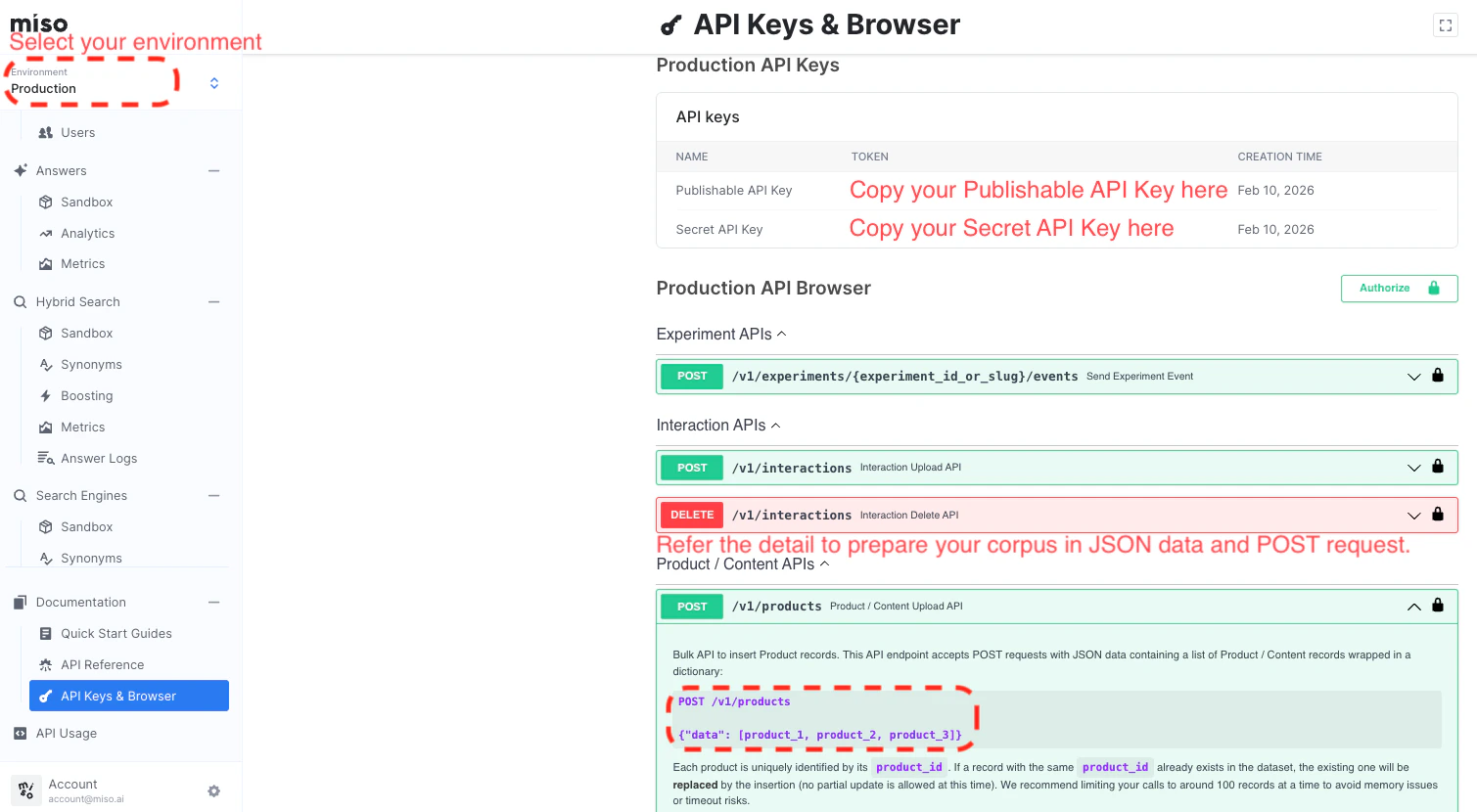 There is one publishable key and one secret key per environment. The publishable key is used in client-side code; the secret key is used for server-side API calls.
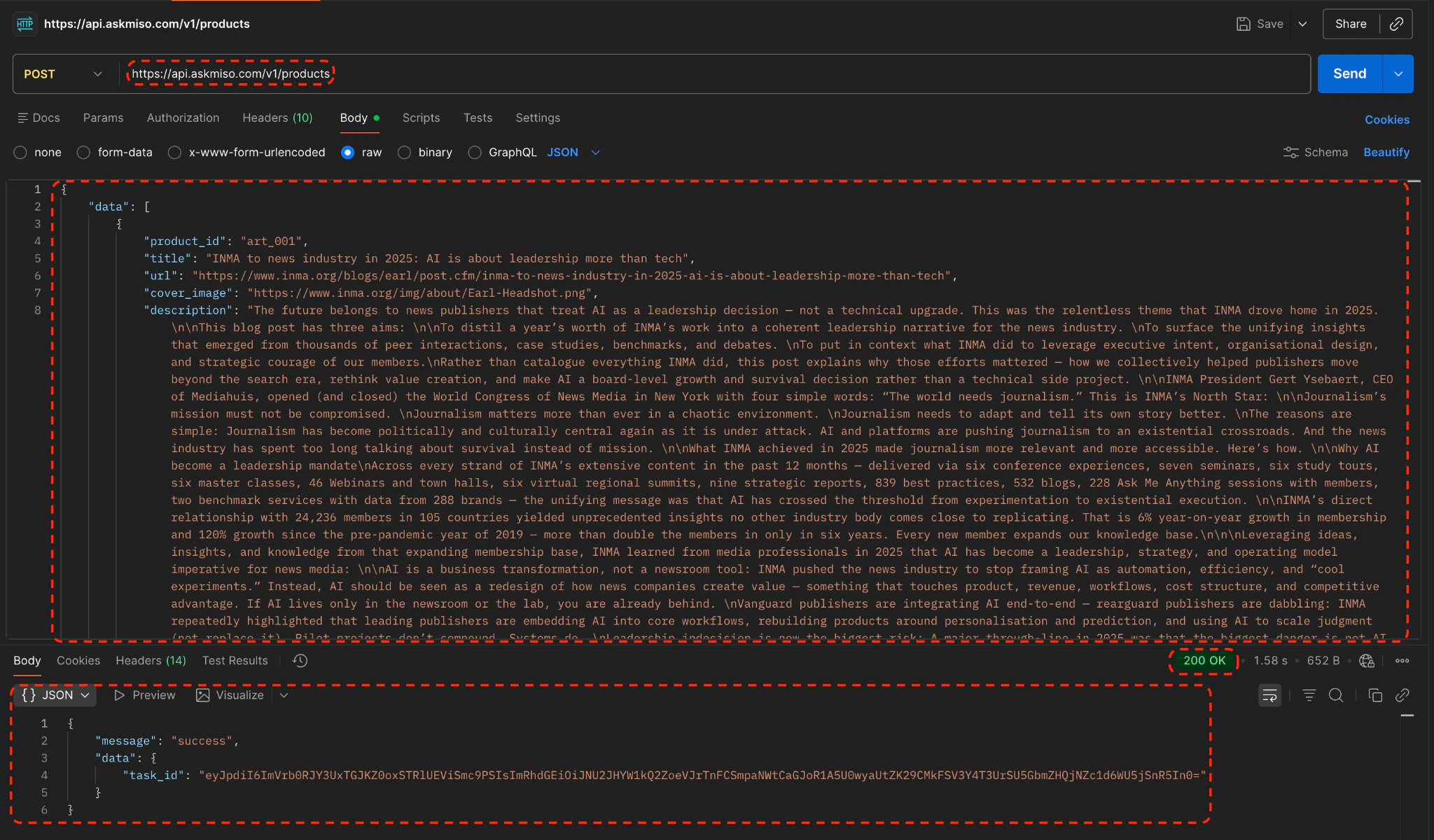
Upload your content to Miso using the [**Product / Content Upload API**](/api-reference/product-content-apis/product-content-upload-api). You can do this with any HTTP client — the steps below use [Postman](https://www.postman.com/).
**Endpoint** — [View full API reference](/api-reference/product-content-apis/product-content-upload-api)
```
POST https://api.askmiso.com/v1/products
```
**Step 1 — Set your request headers**
In Postman, go to the **Headers** tab and add your Secret API Key:
| Header | Value |
| -------------- | ------------------- |
| `X-API-KEY` | Your Secret API Key |
| `Content-Type` | `application/json` |
There is one publishable key and one secret key per environment. The publishable key is used in client-side code; the secret key is used for server-side API calls.
Upload your content to Miso using the [**Product / Content Upload API**](/api-reference/product-content-apis/product-content-upload-api). You can do this with any HTTP client — the steps below use [Postman](https://www.postman.com/).
**Endpoint** — [View full API reference](/api-reference/product-content-apis/product-content-upload-api)
```
POST https://api.askmiso.com/v1/products
```
**Step 1 — Set your request headers**
In Postman, go to the **Headers** tab and add your Secret API Key:
| Header | Value |
| -------------- | ------------------- |
| `X-API-KEY` | Your Secret API Key |
| `Content-Type` | `application/json` |
 **Step 2 — Add your request body**
Switch to the **Body** tab, select **raw → JSON**, and paste your corpus data:
```json theme={null}
{
"data": [
{
"product_id": "art_001",
"title": "Your Article Title Here",
"url": "https://yoursite.com/your-article",
"cover_image": "https://yoursite.com/cover.png",
"description": "A brief description of the article content.",
"html": "" // Full article HTML content, JSON-escaped
},
{
"product_id": "art_002",
"title": "Another Article Title",
"url": "https://yoursite.com/another-article",
"cover_image": "https://yoursite.com/cover2.png",
"description": "Another article description.",
"html": "" // Full article HTML content, JSON-escaped
}
]
}
```
**Step 3 — Send and verify**
Click **Send**. A `200 OK` response confirms the corpus has been uploaded successfully.
**Step 2 — Add your request body**
Switch to the **Body** tab, select **raw → JSON**, and paste your corpus data:
```json theme={null}
{
"data": [
{
"product_id": "art_001",
"title": "Your Article Title Here",
"url": "https://yoursite.com/your-article",
"cover_image": "https://yoursite.com/cover.png",
"description": "A brief description of the article content.",
"html": "" // Full article HTML content, JSON-escaped
},
{
"product_id": "art_002",
"title": "Another Article Title",
"url": "https://yoursite.com/another-article",
"cover_image": "https://yoursite.com/cover2.png",
"description": "Another article description.",
"html": "" // Full article HTML content, JSON-escaped
}
]
}
```
**Step 3 — Send and verify**
Click **Send**. A `200 OK` response confirms the corpus has been uploaded successfully.
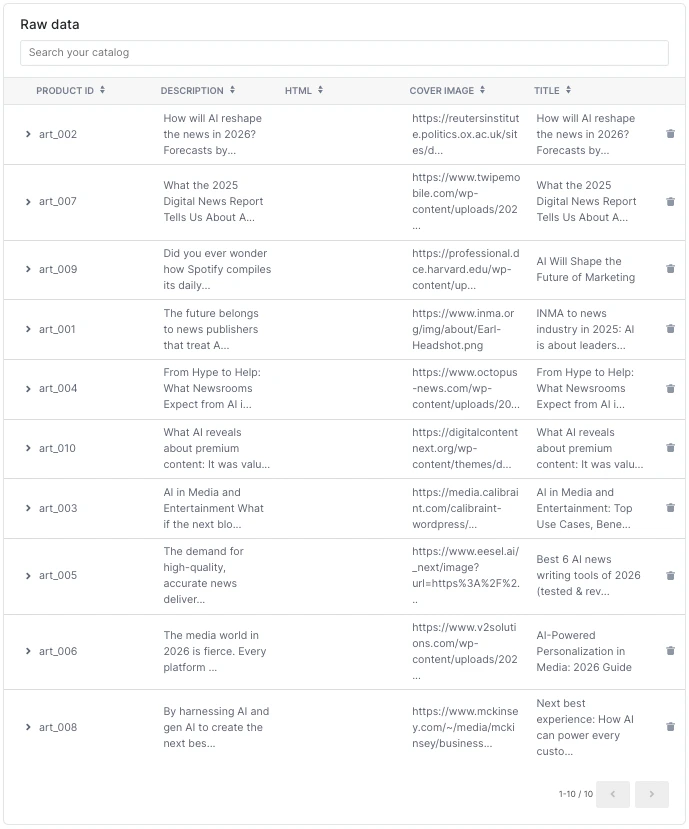
 You can verify the upload under **Miso Dashboard → Data Sets → Catalog**.
 To generate related questions for the Explore module, contact [Miso support](mailto:support@askmiso.com) to add your target environment to the related questions cronjob.
Add the Miso JavaScript SDK to your webpage using either method:
Install the SDK via npm:
```bash theme={null}
npm install --save @miso.ai/client-sdk
```
Then import it in your JavaScript file:
```js theme={null}
import MisoClient from '@miso.ai/client-sdk';
```
Add the following to your ``:
```html theme={null}
```
Since the SDK loads asynchronously, use the `misocmd` queue to ensure your code runs only after the SDK is ready:
```js theme={null}
const misocmd = window.misocmd || (window.misocmd = []);
misocmd.push(() => {
const MisoClient = window.MisoClient;
// Your initialization code here
});
```
**Place the Explore elements** in your HTML where you want related questions to appear:
```html theme={null}
```
**Configure the workflow** by adding the following script:
```html theme={null}
```
Replace `YOUR_PUBLISHABLE_API_KEY` with the key from Step 1, and set `product_id` to match an existing article in your catalog. The `useLink` function controls where users land when they click a related question.
## Complete Example
Here is a minimal working HTML file:
```html theme={null}
Miso Explore Demo
```
Save as `client_sdk_test_explore.html` and open in a browser to see the Explore module displaying related questions for the specified article.
## Live Demo & Visuals
Once configured, the Miso Explore module provides a clean, interactive UI out of the box.
To verify your setup is working:
1. Open `client_sdk_test_explore.html` in a browser.
2. The module will display AI-generated related questions based on the article specified by `product_id`.
To generate related questions for the Explore module, contact [Miso support](mailto:support@askmiso.com) to add your target environment to the related questions cronjob.
Add the Miso JavaScript SDK to your webpage using either method:
Install the SDK via npm:
```bash theme={null}
npm install --save @miso.ai/client-sdk
```
Then import it in your JavaScript file:
```js theme={null}
import MisoClient from '@miso.ai/client-sdk';
```
Add the following to your ``:
```html theme={null}
```
Since the SDK loads asynchronously, use the `misocmd` queue to ensure your code runs only after the SDK is ready:
```js theme={null}
const misocmd = window.misocmd || (window.misocmd = []);
misocmd.push(() => {
const MisoClient = window.MisoClient;
// Your initialization code here
});
```
**Place the Explore elements** in your HTML where you want related questions to appear:
```html theme={null}
```
**Configure the workflow** by adding the following script:
```html theme={null}
```
Replace `YOUR_PUBLISHABLE_API_KEY` with the key from Step 1, and set `product_id` to match an existing article in your catalog. The `useLink` function controls where users land when they click a related question.
## Complete Example
Here is a minimal working HTML file:
```html theme={null}
Miso Explore Demo
```
Save as `client_sdk_test_explore.html` and open in a browser to see the Explore module displaying related questions for the specified article.
## Live Demo & Visuals
Once configured, the Miso Explore module provides a clean, interactive UI out of the box.
To verify your setup is working:
1. Open `client_sdk_test_explore.html` in a browser.
2. The module will display AI-generated related questions based on the article specified by `product_id`.
 API keys can be passed via the `api_key` query parameter or the `X-API-KEY` request header. There is one publishable key and one secret key per environment — use the **publishable key** in client-side code and the **secret key** for server-side API calls.
## Next Steps
Learn how to customize the Explore module UI.
Set up the Ask module to answer user questions.
Full reference for uploading your corpus to Miso.
The underlying API that powers related question generation for the Explore module.
Learn how API keys work and how to authenticate your requests.
API keys can be passed via the `api_key` query parameter or the `X-API-KEY` request header. There is one publishable key and one secret key per environment — use the **publishable key** in client-side code and the **secret key** for server-side API calls.
## Next Steps
Learn how to customize the Explore module UI.
Set up the Ask module to answer user questions.
Full reference for uploading your corpus to Miso.
The underlying API that powers related question generation for the Explore module.
Learn how API keys work and how to authenticate your requests.